Friday, October 27, 2006

Would you know, chuck?

Q1. How much wood would a woodchuck chuck if a woodchuck could chuck wood?

Q2. How many woodchucks would a woodchuck-chucker chuck if a woodchuck-chucker could chuck woodchucks?

Q3. How many woodchuck-chuckers would a woodchuck-chucker-chucker chuck if a woodchuck-chucker-chucker could chuck woodchuck-chuckers?

Q4. How many woodchuck-chucker-chuckers would a woodchuck-chucker-chucker-chucker chuck if a woodchuck-chucker-chucker-chucker could chuck woodchuck-chucker-chuckers?

Q5. How many woodchuck-chucker-chucker-chuckers would a woodchuck-chucker-chucker-chucker-chucker chuck if a woodchuck-chucker-chucker-chucker-chucker could chuck woodchuck-chucker-chucker-chuckers?

Thursday, July 20, 2006

Solo

I'm alone this weekend. All my p e o p l e are away - every last one - mostly at Buddhafield, though one or two at things like stag weekends and Ethiopian nomad conferences and such.

So I am bereft. And I've been missing them, more than I thought I would. I used rarely to miss people - though I'm not sure I ever knew such extraordinary and strange ones as these. Perhaps I'm changing, becoming more peoply, less sharp around the edges.

Today, alone, I set out in search of a cool, green, quiet spot to sit and read. I trudged sweatily up to the top of the cemetery. The cool thing didn't work out particularly - it just hasn't been that kind of a day - but green it certainly was, and quiet. The kind of quiet that includes the snuffles of unseen creatures, the yaffling of green woodies and the chipping of wrens. Brighton's Victorian Extra-Mural Cemetery is a beautifully-kept place: perfectly balanced between manicured and wild. And it seems to me to have more life in it than anywhere else in the city.

I watched a fox wrap itself lovingly (or itchingly) around the slim base of a cherry tree. A squirrel crept towards me, its eyes fixed on mine, grabbed the apple core I'd thrown into the bush and scuttled up to nibble it carefully on a low branch while long-tailed tits sung and sparkled around it like angels. Not a jot was wasted or dropped until the end, and I swear it used the bare stalk to clean its teeth. An ant might come across that, carry it away to clean off any remaining sweet juices; then some lignolytic community would move in...

Cemeteries are good for seeing the cycles of nature. Atoms of Brighton people of ages past, singing and sparkling, creeping up for apple-cores, wrapping themselves around cherry trees.

Sunday, July 16, 2006

Darkness

Last night, and this morning, I breathed life back into a half-finished project from a couple of years ago: hand-sketching little constellation charts.


(with a little help from Skyglobe, the very program I used to learn constellations fifteen years ago, in full DOS glory)


I stopped originally when it became frustratingly clear that they were bugger-all use in Brighton, where you're lucky if you can make out the Big Dipper. The rest of South East England isn't a great deal better.

But I've been re-inspired by finally deciding to visit, perhaps in October, the place with the darkest sky in the UK.

How often do we experience the real darkness of the night? Or the real silence, for that matter? Not just the absence of light, or noise, but the living magic of the night, undulled by the atmospheric glow of street-lights or traffic noise?


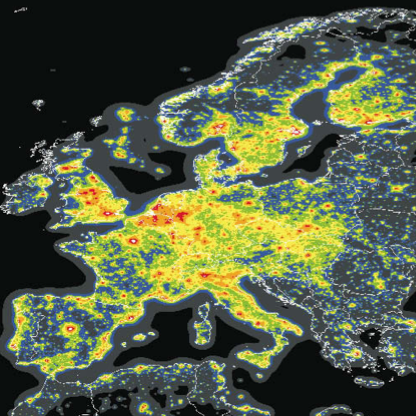
(Source: The World Atlas of Artificial Night Sky Brightness)


According to this, if you're anywhere in Europe the answer is you don't, unless you live on certain small patches of arctic Sweden or Finland, a couple of tiny Greek islands, or the extreme North West of Scotland.

The map shows the brightening of the sky due to artificial light. The light is reflected, scattered, diffused, from particles in the air and from the very air itself. Red represents the most glow, blue the least. If you're lucky enough to live in a grey patch, you'll have no discernible light pollution vertically upwards, but there may be some glow nearer the horizon. Only in the black areas will you see a 'true' night sky, from top to bottom.

So where are the darkest, clearest night skies in the UK? They're at the point of the UK furthest from Brighton! Yay! Not to mention the highest cliffs on the mainland! So I'm off for a week or two in Cape Wrath, and I'll take my sky charts with me. Bye bye Brighton!!

But not just yet - cause... well... you know. The beasties.
Soon. Soon as they've gone.

Monday, July 10, 2006

Space balls


Take a look at Hakan's* space balls!

Complete with weird space-music! (there's a little green play button). Even so, I do like this kind of thing. There's nothing so pure and stunning as a sphere, and some of the spheres out there are beauties. I knew that some were a lot bigger than others (I've seen the numbers), but you don't really see until someone shows you.

Even then, let's be honest, we don't really see. How could we ever. But throw in imagination, wonder and a clear, dark sky and we're getting somewhere.

(*no relation to our friend at spacemind.net)

Hello again. It's been a while. I sent my laptop to the hospital in June, and it's come back far, far happier after a few weeks of treatment. So I thought, well, maybe one little blog post to celebrate. Now that everyone's stopped looking.

Keeping the weird music theme going (not to mention balls), I also had this urge to share my silly text interchange of the week.
After looking at the program for the upcoming WOMAD (World Of Music, Arts & Dance) festival:

B:
How about we do our
own Garage Of Noise
And Dance festival?

D:
Yes! and followed by
World Of Music, Biscuits
And Tea

Further suggestions welcome, of course...

Saturday, June 17, 2006

Arctic wonders

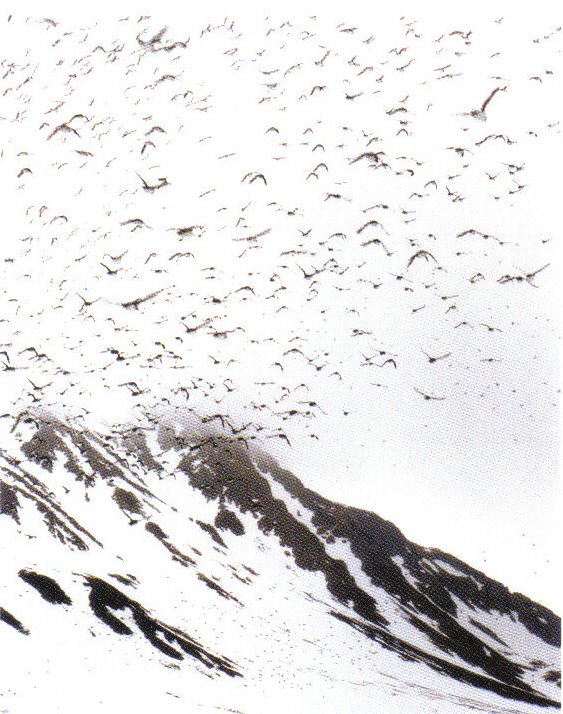
Yesterday I had a day out at the Natural History Museum, including one of the most quietly thrilling exhibitions I've ever seen.

But I know better than to try to compete with Toast in the telling of a story.

Monday, June 12, 2006

On the millionth day of christmas

my true love gave to me
One million cows.

Saturday, June 10, 2006

Songs of the Planets

If you haven't yet had the pleasure of hearing sounds from other planets - such as the dawn chorus on Jupiter - then have a listen here.

Thursday, June 08, 2006

Cube, Part the First

Today: something cubish. Bear with me on this one.

1D: If you have a little line, you can use it to represent any 'bipolar' situation, like the potential outcomes of tossing a coin. You could label the ends H and T, or, if you like a spot of binary, 0 and 1.

2D: If you have a square, the four corners could represent the possible outcomes of tossing two coins (HH, HT, TH, TT). You might label them 00, 01, 10, and 11.
3D: A cube has eight corners (000,001,010,011,100,101,110,111). Looked at in a certain way, it's a map of the eight possible states of a three-bit computer. You could use this computer to store the result of three coin tosses, or perhaps a letter from a to h. At any one time, your computer would inhabit one corner of the cube. The cube is its little world of potential: if you give it a different letter to store, or a different set of coin toss results, it moves to a different corner of its world.
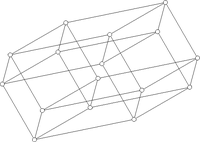
4D: A 'hypercube', has 16 corners. (If you're curious about cubes in four dimensions, there's a lovely explanation here - scroll down to 'Analogies to Lower Dimensions' and enjoy.) A computer living here would have four bits - a semibyte.

The laptop I'm typing into has a modest 80GB of storage, which is about 687 billion bits. It lives in a 687 billion-dimensional cube, flitting from corner to corner like a fly in a box. Every stroke of the key sends it to another corner. Even when I stop, it flits through dimensions I'm not aware of. I can hear it. Flitting.

One can't help feeling pity for the poor thing...

And it was between such bouts of pity that I took to wondering what it might be like in 687 billion dimensions (invariably a good move if at any time you find yourself fed up of any form of compassionate state).

A spot of Pythagoras (or a quick sketch with a ruler) will tell you that the diagonal of a 1cm square is about 1.4cm long. The equivalent distance for a 1cm cube - in a straight line between opposite corners - just over 1.7cm.

If you're ever trapped inside a 1cm crouton, or a sugar cube, you'll always be able to stretch out to 1.7cm long if you need to.

Picture now a sugar cube in 687 billion dimensions, still just 1cm across. The distance between opposite corners? A little over 5 miles.

This exercise has helped me come to terms with the plight of my flitting friend; and maybe it can help you too. No more fly in a box visions for me. I see my sweet laptop soar on snow-white wings through miles of sparkling space, to liquid crystal heights and diaphanous digital depths, and I am at peace.

Friday, June 02, 2006

Life of an ageing star

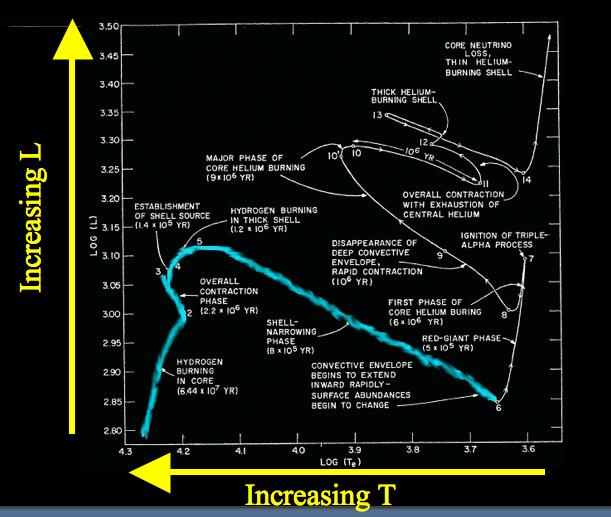
Click picture for detail.
They have complex lives.

Sometimes I think I liked them better when they were just white dots and they all looked the same.

(Sometimes I think that about people too.)

Other times I marvel. And I do like a good marvel.

Here's the current extent of my understanding:
It starts at the bottom-left and follows the wiggly path. If it goes right, it's getting redder; if it goes left, it's getting bluer; if it goes up, it's getting brighter. When it gets to the top it goes boom.

From star evolution lectures.

Thursday, June 01, 2006

Upon going to sleep

Made tired by the day now,
my passionate longing
shall welcome the starry night
like a tired child.

Hands, leave all your activity,
brow, forget all thought,
for all my senses
are about to go to sleep.

And my soul, unguarded,
will float freely
into the magic circle of the night -
deeply and a thousand times alive.


The third of Strauss's Four Last Songs: one of the most emotionally powerful - and yet peaceful - pieces of music I have ever heard. And I have heard it a lot of times. The poem ('Beim Schlafengehen') is by Herman Hesse. Strauss's setting is certainly not a numbing drift into sleep: nope, we're talking serious yearning and ecstatic flight of the soul treatment here.

This is my favourite translation - I'm afraid I don't know who it's by. I've adulterated it a little at the end (before I messed with it, the above translation ended in order to live in the magic circle of the night/ deep and a thousand fold.) because I wanted to accommodate a different version of the last, ecstatic line that thrilled me in a subtitled performance on the tv several years ago. Apologies to those with a better grasp of poetic coherence than me.